SCOPE & OUTCOME
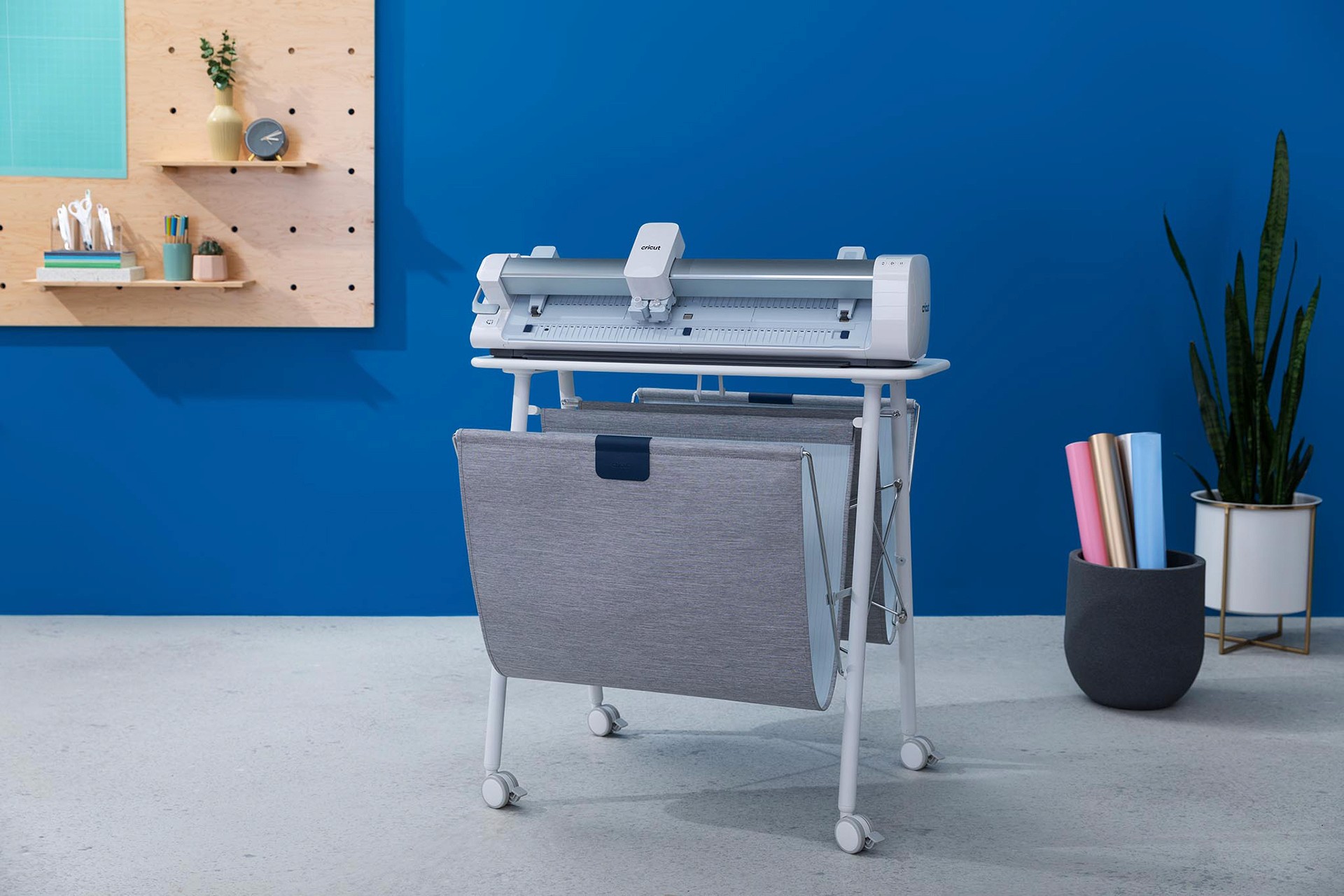
The initiative I was hired for spanned hardware, firmware, software, materials science, legal compliance, manufacturing, and customer experience. The goal was to bring industrial fabrication capabilities to everyday creators while preserving the simplicity Cricut customers expected.
Although the laser cutter itself was canceled shortly before launch, many of the interaction models, visualization techniques, onboarding experiences, and platform principles developed during the project lived on. The work became a catalyst for a broader redesign of Cricut's software ecosystem and continues to influence products shipping today.
MY ROLE
As Group Product Manager, I built a vision of SW for our ecosystem of new machines, and led product strategy, customer research, experience definition, and cross-functional alignment.
My focus was defining how a consumer laser cutter should work for people with no fabrication experience while helping shape a broader vision for Cricut's software platform. This included opportunity identification, workflow design, roadmap development, customer validation, product launches, data strategy, and executive alignment.
THE CHALLENGE: design software for people who aren't designers or engineers.
Most fabrication software assumes users already think like fabricators.
Cricut customers don't.
They aren't starting with geometry, layers, operations, or machine settings. They're starting with a gift, a decoration, a keepsake, or a business idea.
The challenge wasn't teaching people how laser cutters work.
It was making laser cutters work the way people already think.
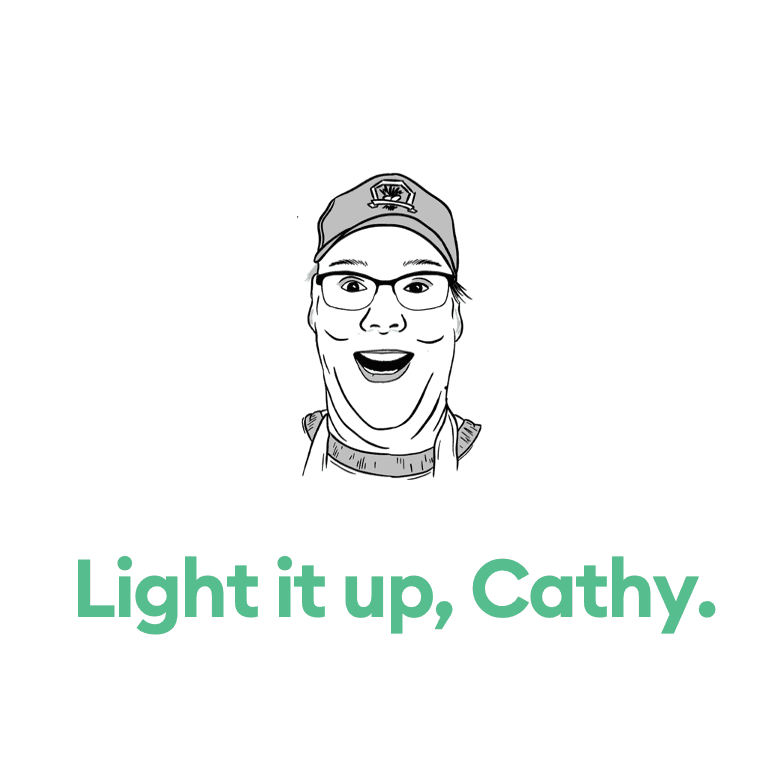
To align internal stakeholders and maintain user focus, I illustrated Cathy, who started as a persona but became a mascot - and later, dare I say, an icon.
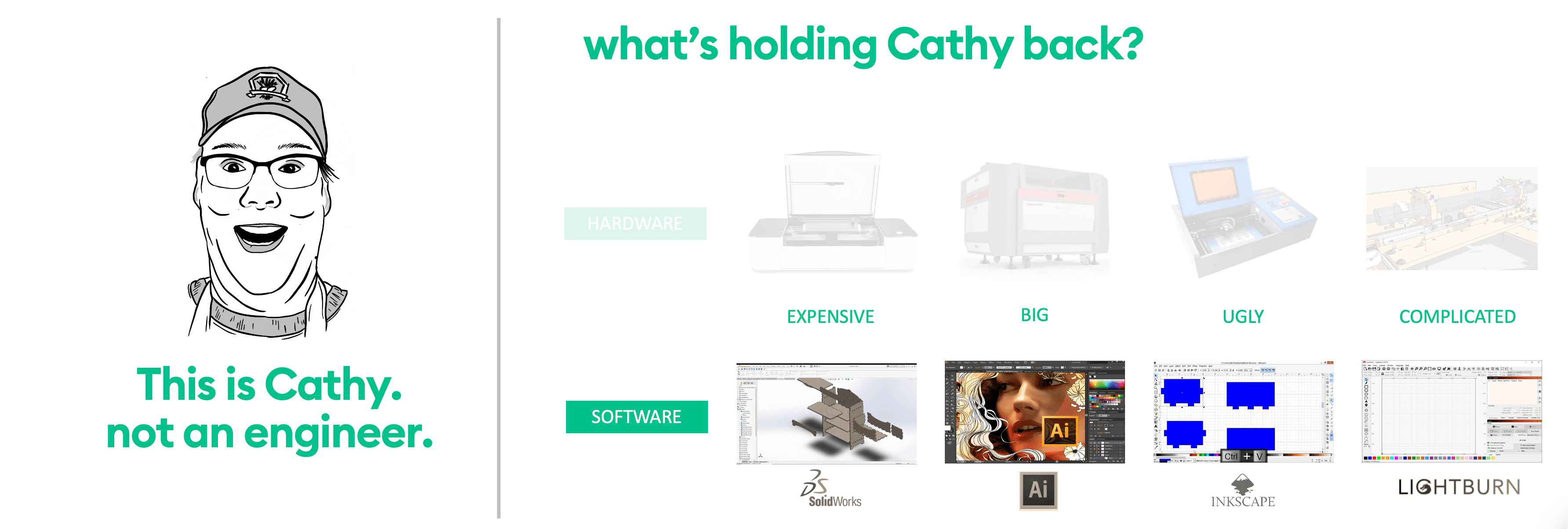
THE CORE INSIGHT: Cathy doesn't design files. She imagines outcomes.
Most fabrication software asks users to think in geometry, layers, operations, and machine settings.
Our research suggested that customers think in finished objects.
Instead of exposing technical complexity up front, we explored ways to help users visualize the final result while surfacing only the tools relevant to the task at hand.
That principle became the foundation for nearly every software concept that followed.
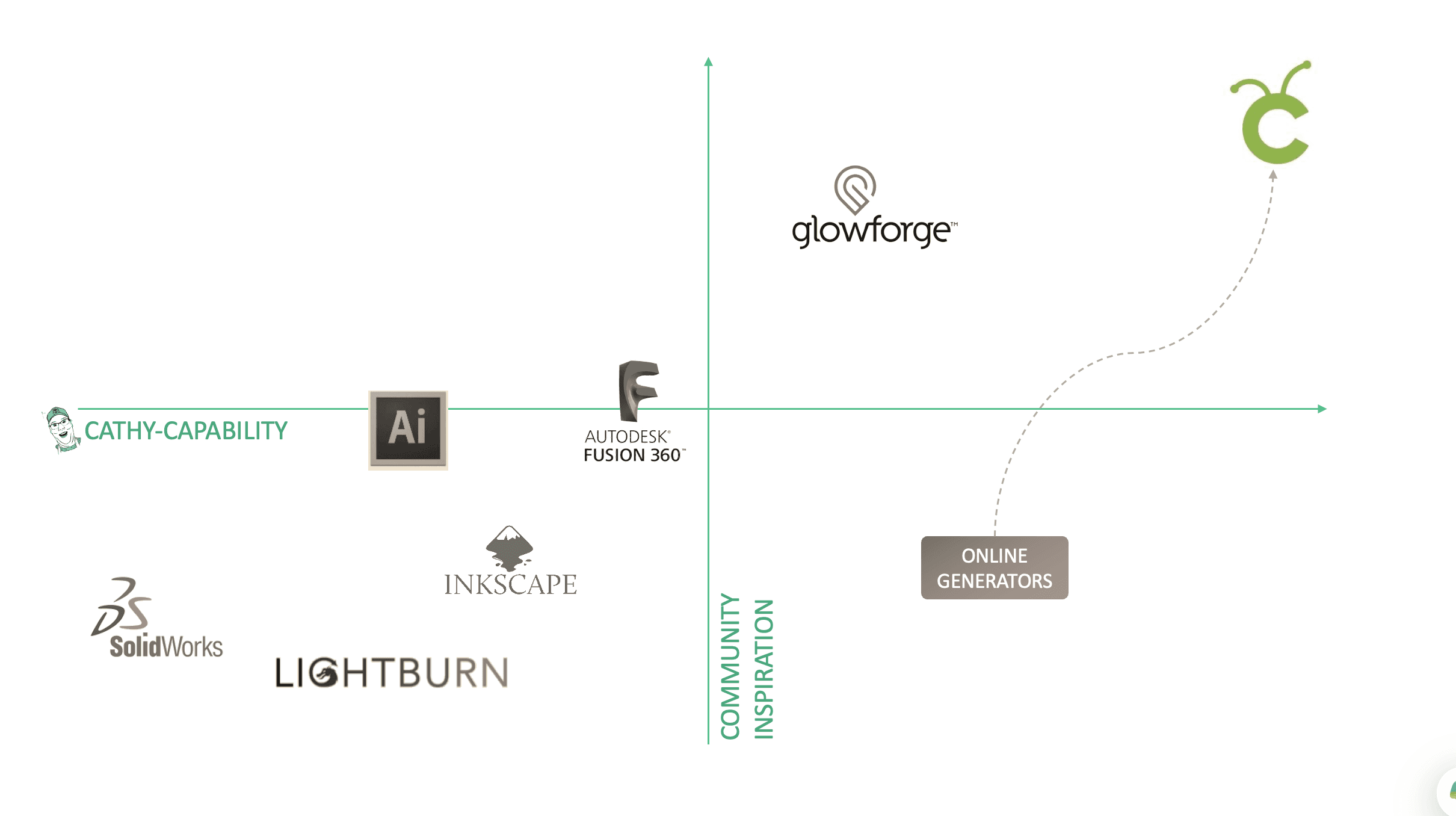
On top of that, competitors in the market had four core issues that we needed to beat:
Overwhelming interfaces
Complicated options
No inspiration
No clear path to creation
One of our guiding principles was "Cathy-capability."
Not "how much capability do we offer", but "how much capability that Cathy can get on board with."
CHALLENGES WE TACKLED
Sadly I can't share too much on this, but can speak broadly about a few key problems that our teams solved:
PROBLEM
Cathy is overwhelmed by the number of tools/options she's confronted with at any given moment.
SOLUTION
A new contextual tool system that gives Cathy what she needs when she needs it - providing a clear path to creation.
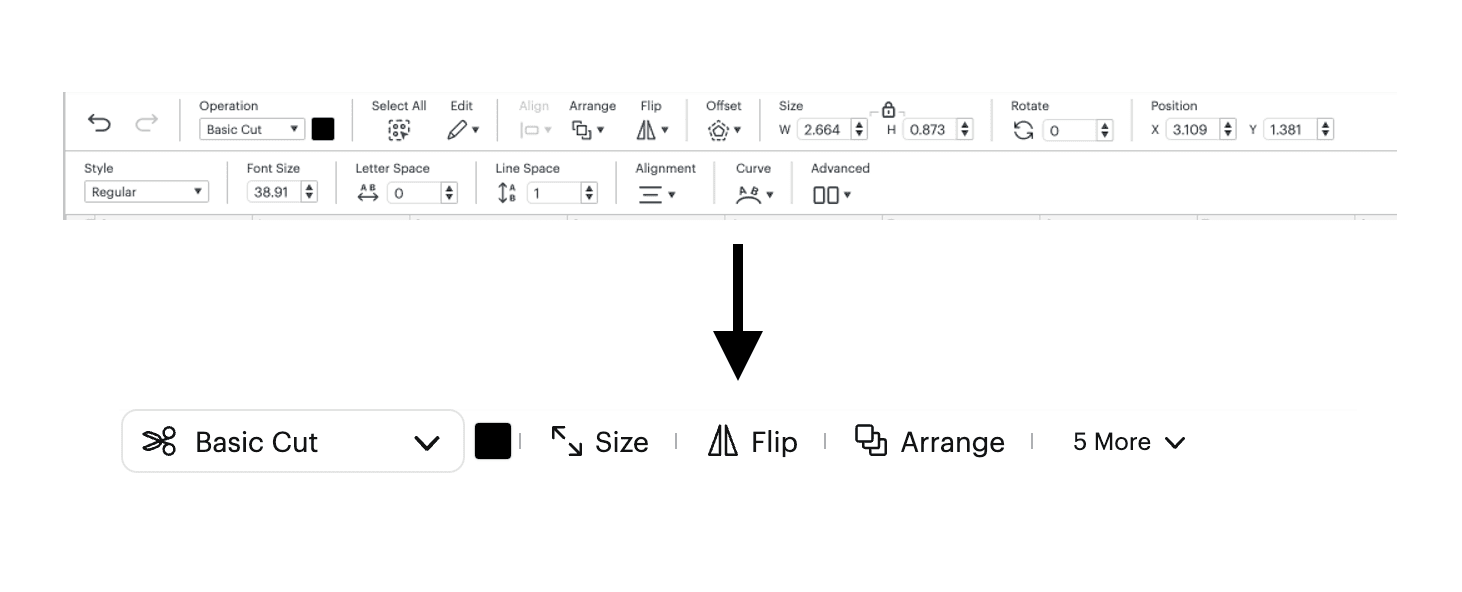
PROBLEM
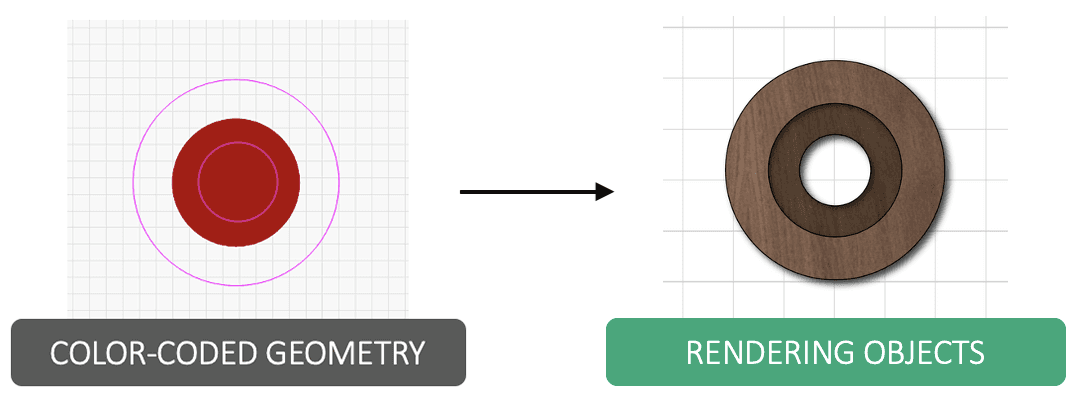
Cathy wants to visualize her final project - not color-coded geometries that represent operations.
SOLUTION
What-You-See-Is-What-You-Get visualization and workflows based on materials selection.
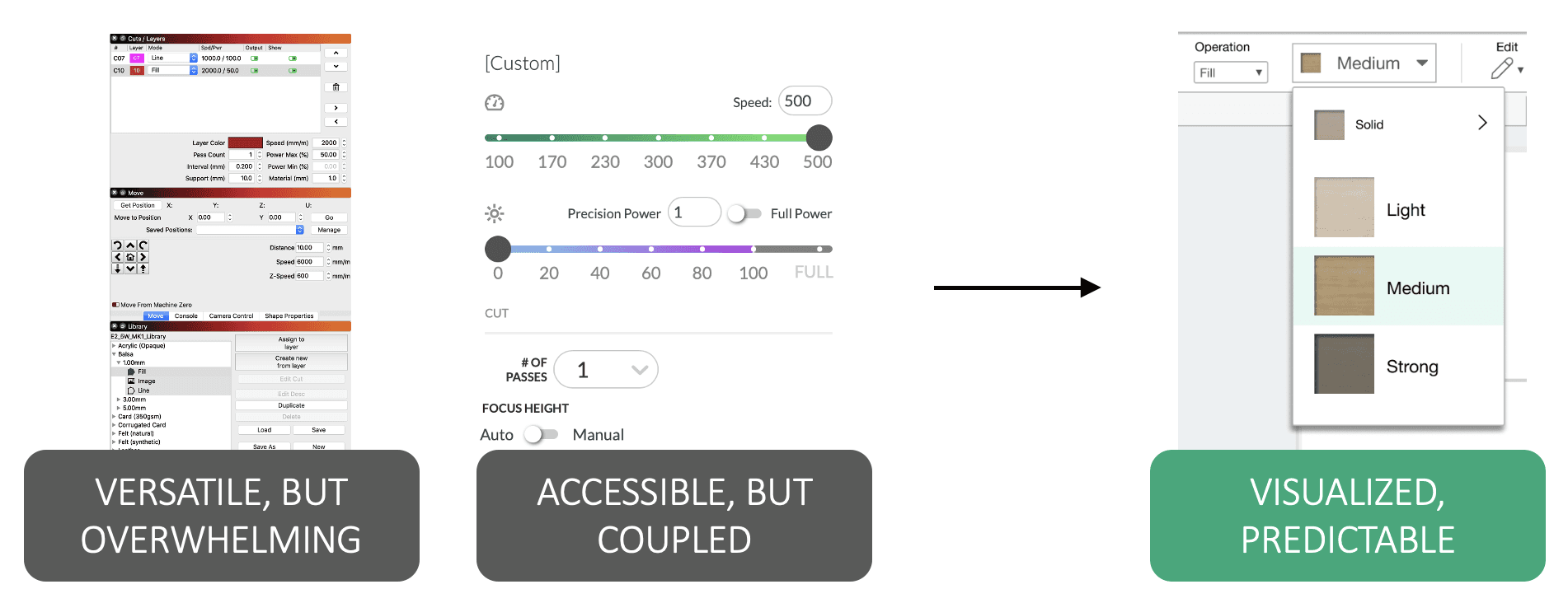
PROBLEM
Cutting options on the market are either too complicated, or simplified but coupled, making it difficult for Cathy to predict outcomes at the machine.
SOLUTION
By moving materials selection earlier in the process, we were able to provide visual renditions of tested-and-true options.
PROBLEM
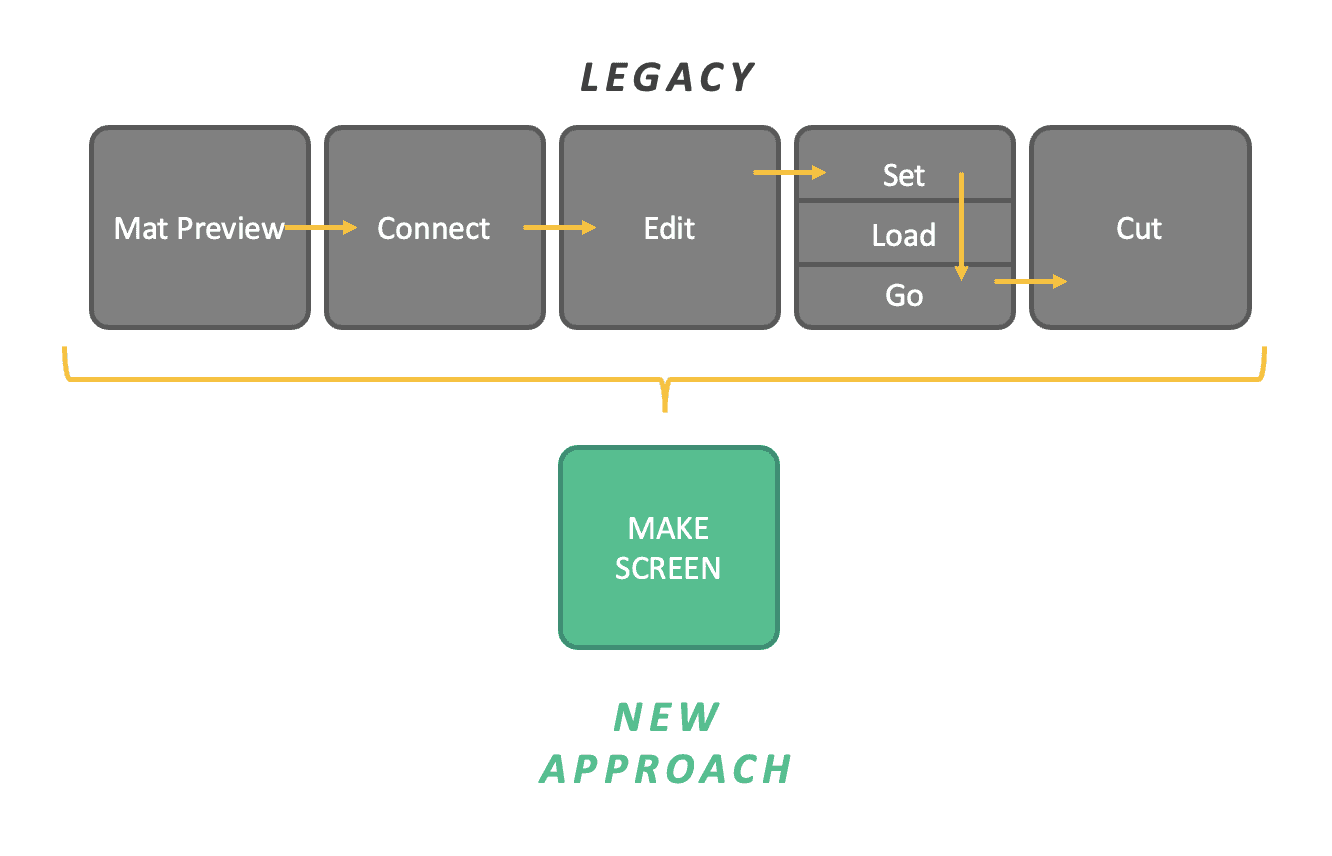
Cathy is confused by the fact Design Space has oen place to Design, but multiple, unforseen steps to Make.
SOLUTION
We consolidated to work environments to be just two spaces: one for designing, and one for making.
PROBLEM
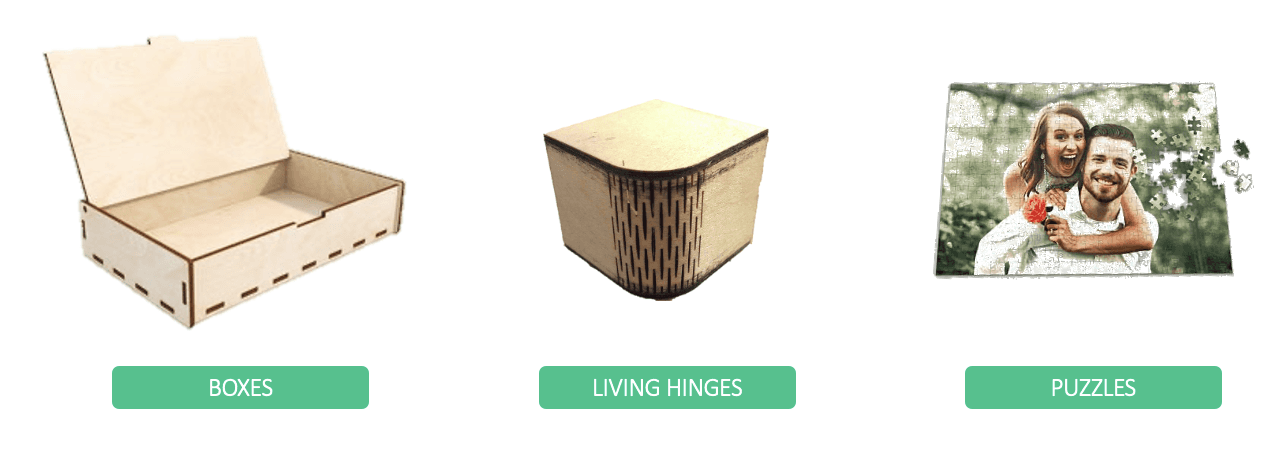
Many core use cases for the laser were simply too complicated for Cathy to pursue with existing tools.
SOLUTION
Generators that parametrically-drive geometries behind the scenes, so all Cathy has to do is choose a few options, and she's ready to cut!
THE CURVEBALL: One month before launch, the machine was canceled.
After nearly three years of development, Cricut canceled the laser cutter initiative shortly before launch.
The obvious question became:
Should the software vision disappear too?
The answer was no.
THE SW VISION EXPANDED FROM LASER MACHINE TO DESIGN PLATFORM
Following the cancellation, my team and I led an effort to preserve the strongest ideas from the project and adapt them for Cricut's broader ecosystem.
The result was a strategy for a next-generation Design Space ecosystem built around:
Contextual tools
Simplified making
WYSIWYG project visualization
Machine connection moved behind-the-scenes
A modernized visual design system
Much of the underlying work had already been researched, designed, tested, and prototyped. Rather than abandoning it, we repositioned it as a long-term platform investment.
A lot of that vision is still being built, so I can't show much, but I'm happy to discuss further.