


ROLES
Product & Interaction Design
Industrial Design & 3D Printing
AI-Assisted Engineering (Python, Swift)
Electronics & Hardware Prototyping
iOS App Design
SCOPE
Design and build a dynamic display for a vintage convertible that feels original to the car, stays readable in direct sun, runs on its own in a car's electrical environment, and is controlled by a single knob — with a companion app for the moments you need more.
OUTCOME
A working system on final hardware: six display modes, knob control with 1–2 second refreshes, background music sync from Apple Music, and a native companion app. In-car installation, ignition-aware power, and engine data are next.

dynamic information without the black rectangle.
A glowing tablet on a '65 dash breaks the spell instantly. In a convertible, it's worse: with the top down, sun washes backlit screens out. I wanted music, time, photos, and engine data without anything that looked or behaved like a modern screen.
an instrument, not a screen.
The '65 dash is a row of round chrome gauges, so anything new should read as one more. It should reflect light, hold still, answer to a knob, and look factory-original when the car is off.
01 / Make it feel like it came with the car.
PROBLEM
Backlit screens look unmistakably modern behind chrome and wood grain, and they wash out in direct sun.
SOLUTION
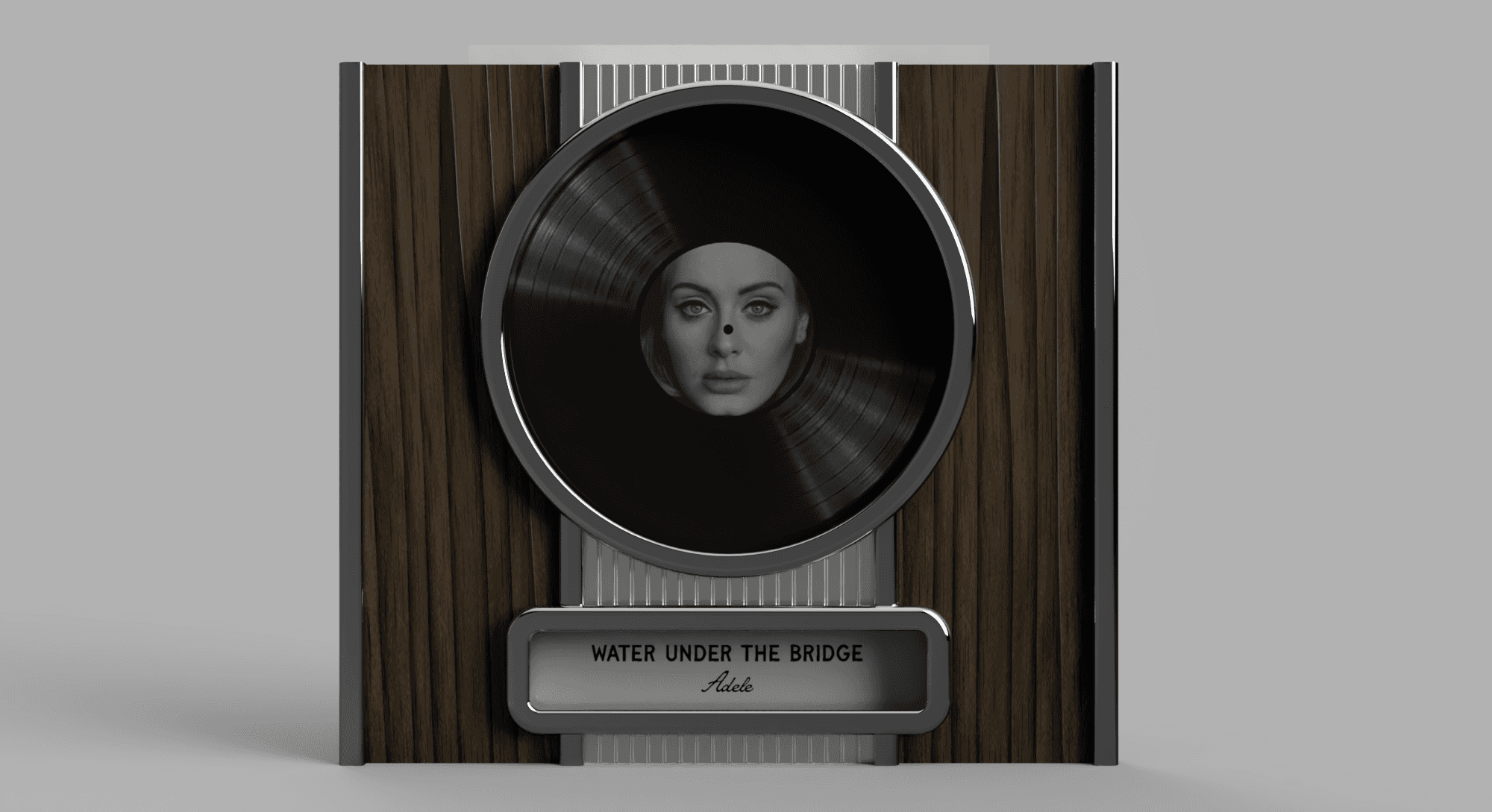
One e-ink panel sits behind two chrome-bezeled cutouts, reading as two separate instruments on the center console compartment door. E-ink reflects light like paper, so it's easiest to read in full sun. It also holds its image at zero power: parked, the pony logo stays on like a dashboard badge.


03 / Built for the road, and the garage
PROBLEM
Cars cut power without warning, can't have their batteries drained, and offer no monitor when something breaks.
SOLUTION
The power-management system is designed to wake with the ignition, sleep when parked, and eventually shut down completely to protect the battery.
04 / A companion app worth opening
PROBLEM
You rarely need an app for a car accessory, and when you do, it feels like configuring a router.
SOLUTION
The app is optional, so the moments you open it should feel like reaching into the dash: the car's own dash as the background, a simulated e-ink display, map-light highlights on selections, and a Mustang-style pull knob with haptic clicks.


05 / In and out with a couple of screws
PROBLEM
Custom electronics in a classic car usually mean permanent modifications and tangled wiring.
SOLUTION
The system lifts out as one unit: one wire pack, two screws. The slim 3D-printed mount uses minimal fasteners, hides all of them, and keeps the memory card reachable for updates.
06 / Built to grow
PROBLEM
Hobby projects become dead ends when every new idea needs a rebuild.
SOLUTION
A simple one-knob system that cycles through modes leaves room for future features, like reading data from the car's fuel injection system. And the industrial design prioritizes ease of assembly and disassembly, making it simple to swap out components any time.


BUILDING WITH AI: from product requirements to working hardware
I'm a designer, product manager, and mechanical engineer, not an embedded developer. AI made this possible, but I enjoyed running it like a product team, not a vibe-coding session, and my knowledge of software engineering principles allowed me to fill in the gaps.
Requirements first
Acceptance criteria for every mode and behavior, kept as the source of truth.
Decisions on record
A running log of why, including rejected alternatives.
Review and verify
AI code reviews caught a crash loop and two threads fighting over the display. Every component was tested on hardware, and I corrected the AI when its advice didn't match my bench.
iOS app built in Swift, Raspberry Pi in Python

Outcome & Learnings
Lucille runs on final hardware with six modes, knob and app control, and music that follows from my pocket. In-car installation and engine data are next.
It reinforced a belief: the best technology disappears into the object it serves. And with AI as a partner and real product discipline, one designer can get from sketch to a working, multi-platform product.
Next Steps
Carve openings in steel door
Mount the system
Connect it to power and DRIVE