SCOPE & OUTCOME
This immersive research initiative explored how full-time liveaboards experience life within marina communities. Through interviews, observation, co-design sessions, and iterative prototyping, we uncovered a surprising insight: the greatest opportunity wasn't improving boats or docks—it was improving the relationships between the people who used them.
We discovered that marinas functioned like parking lots rather than neighborhoods, leading us to reimagine dock design as a tool for building community, connection, and belonging.
MY ROLE
Contributed across ethnographic research, systems mapping, persona development, opportunity identification, concept generation, co-design facilitation, prototyping, and solution development as part of a four-person interdisciplinary engineering team.
BACKGROUND
My team of four engineers was tasked with choosing a group of people to study and develop a solution to make their lives better. The ambiguous nature of the semester-long assignment allowed us total freedom to explore deeply every aspect of the lives of people who live on boats year-round, identify areas of opportunity, scope the solution space, design with our users, and develop a solution that would have a truly meaningful impact on the lives of a variety of personas, as well as their community as a whole.
PROCESS
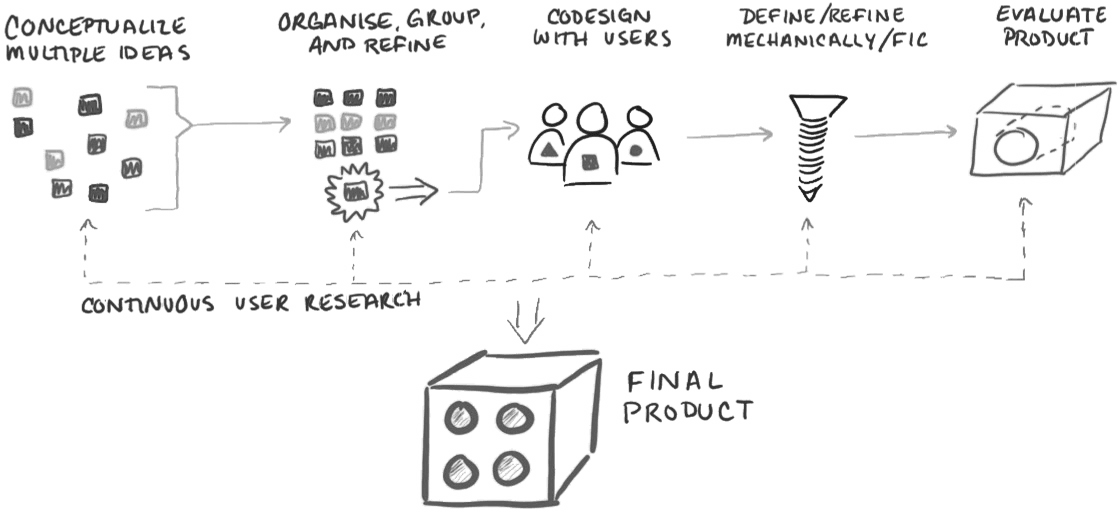
It was important to our project that we manage a process that was fluidly iterative, but that also had concrete phases to dictate milestones, metrics, and, more practically, scheduling with our users, who were our focus throughout.
PHASES
Given the broad scope of the project exploration, and the end goal of an unrefined concept, the team chose to divide four phases: Exploration, Ideation, Codesign, and Refinement.
PHASE 1 EXPLORATION
Given the broad scope of the project exploration, and the end goal of an unrefined concept, the team chose to divide four phases: Exploration, Ideation, Codesign, and Refinement.

SOAK
Immersing ourselves in the lives of liveaboards, we knocked on hulls, asked questions, toured yachts and sailboats, grabbed the same cabinets that they do when waves hit the side, learned the ins-and-outs of sailing... really soaked the sponge.
SQUEEZE
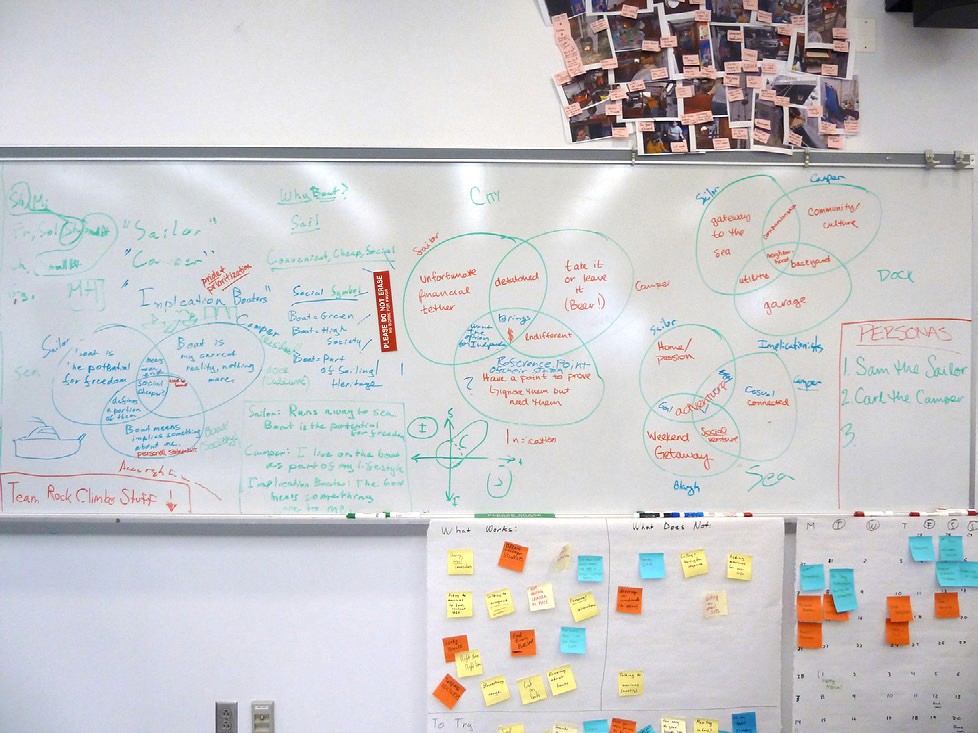
After every visit, we sat around a table and squeezed the sponge - dumping, organizing, and evaluating every observation, thought, insight, and oddity. We then developed frameworks for building personas and identifying areas of opportunity.
PERSONAS
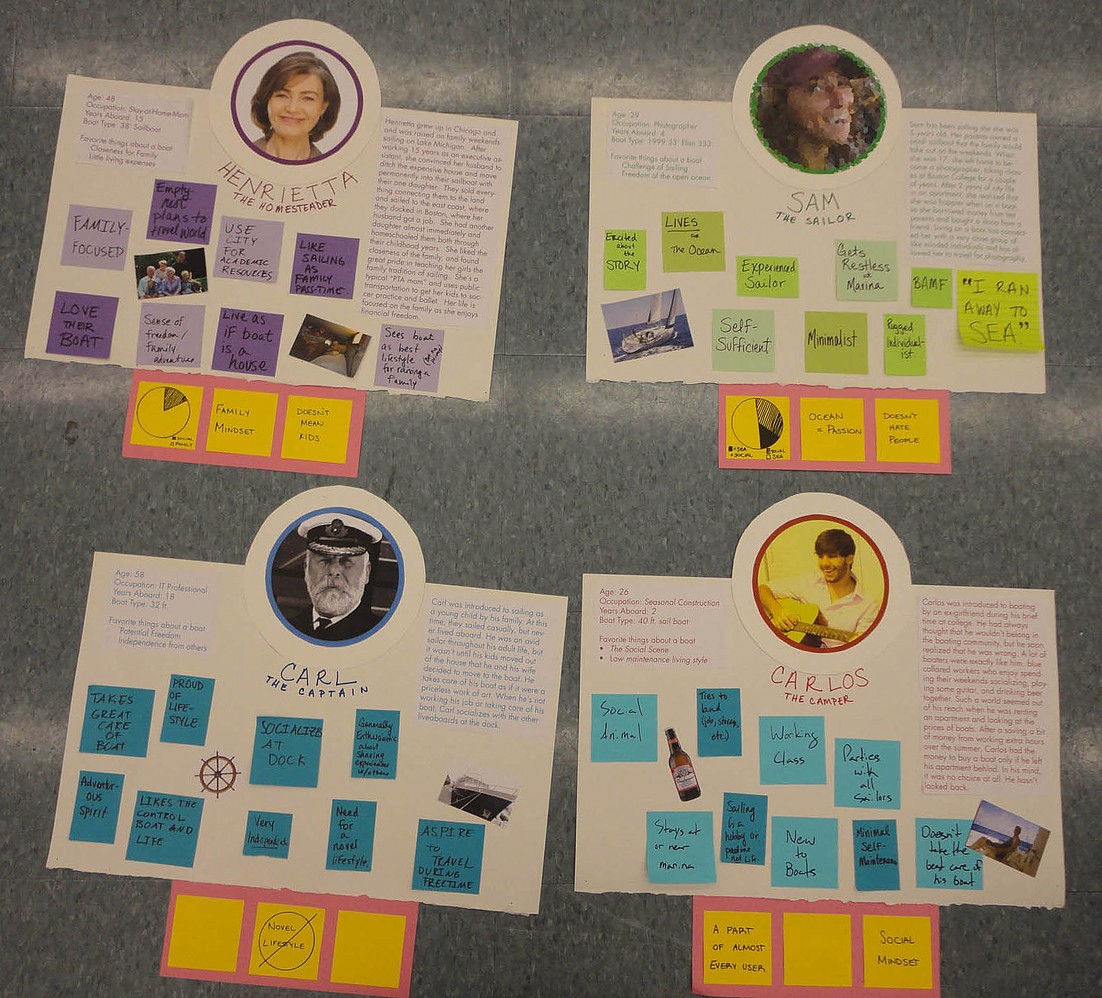
Developing meaningful personas was critical to our upcoming ideation process. These were thoughtfully-crafted characters with back-stories - operating as mindsets that users might have when responding to certain ideas or product features. Derived from a framework of where liveaboards find pride (The Sea vs. The Docks vs. The Boat), each persona told us a story every time we developed new ideas.
KEY INSIGHTS
• Space and storage are always the first things liveaboards mention.
• Each user has a unique motivation for living on
a boat.
• The docks are tight-knit communities, but there’s not really much space to interact.
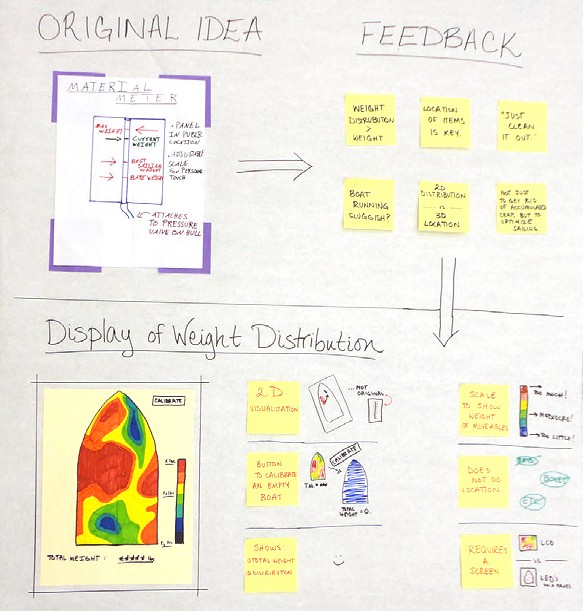
• Weight distribution is a key concern for most liveaboards.
• They feel free.
PHASE 2 IDEATION
Key insights were synthesized to brainstorm areas of opportunity, evaluating the impact of solutions through the lens of our personas.

OPPORTUNITIES AND SOLUTIONS
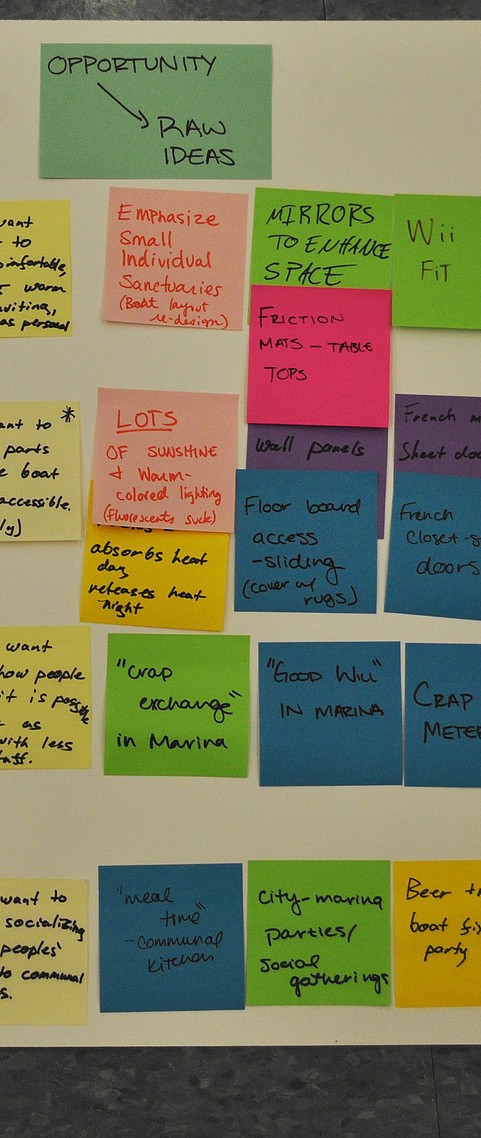
We spent a concentrated month on creating, organizing, evaluating, and refining hundreds of ideas using a myriad of brainstorming methods. All options were on the table, from robotics to architecture to sewage systems. This was the broadest point in the process in terms of project scope, and required a great collaborative effort to bring blue-sky ideas down to reality, and to bring lame ideas into meaningful territory.

9 POSSIBILITIES TO TEST
We finished the phase on time with 9 gallery sketch proposals to bring to our users. These included everything from weight-distribution heat-map apps to boat towing systems, to docks that are designed to facilitate more social interactions.
KEY INSIGHTS
• Big logistical opportunities in the realms of maintenance, storage, and marina navigation.
• Community is a major motivator for living on a boat, but docks are like parking lots.
• What started as some of our worst ideas became meaningful solutions.
• Interdisciplinary brainstorming can be intense, and managing fault lines in team dynamics was critical to success.
PHASE 3 CO-DESIGN
Perhaps the most critical stage in the project, Co-Design was all about taking our ideas to the users not just for feedback, but to actually sit down and let them take part in the design process. This brought about a rich perspective on our false assumptions, while validating and invalidating various parts of our ideas and personas.
THE KIT
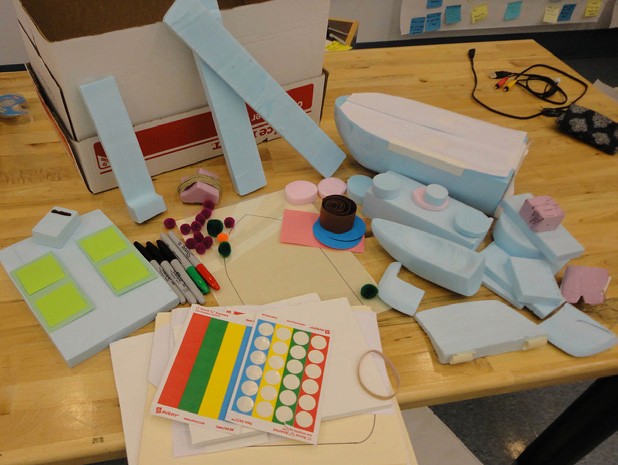
Designing with users was an extremely tactile experience. We developed a sketch-model kit to help them visualize and critique
our ideas as well as create their own.
Users were breaking off pieces of blue foam boat, drawing heat maps on transparencies for app interfaces, labeling problem zones of the docks, and drawing on napkins thoughts they had trouble verbalizing.
THE RESULTS
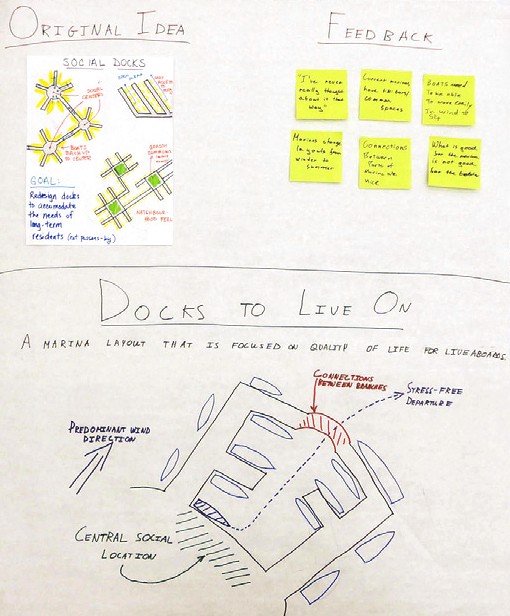
Three primary ideas moved forward after our co-design research: a “barnacle roomba,” “docks to live on,” and a weight distribution system.

KEY INSIGHTS
While this phase was chockfull of insights into the minds and worlds of users, as well as the design process and user research techniques, there was one major heuristic that wound up defining the entire project:
Often, it’s about what they don’t tell you.
Users never expressed dissatisfaction with the way docks are designed, but when we showed them Social Docks, they were neither excited nor dismissive, but intrigued. They were a community of homes, but they were living in a parking lot, not a neighborhood, and they’d never considered that.
PHASE 4 REFINEMENT
Based on results of our design sessions with users, we developed and designed the completed solution: a dock to live on.

A DAY IN THE LIFE
With the revelation that we had the opportunity to seriously improve communities for liveaboards, we completely revamped our social docks idea to be simply a neighborhood. Where the Sailor Sam persona could escape to the sea the moment she begins to feel antsy, to a place where Henrietta the Homesteader’s kids could expend energy off the boat.
We took earlier story maps about typical days-in-the-life (example left) and used those narratives to develop a new dock system that would bring the community together but provide solitude and adventure all the same.

SOLUTIONS
A Open-to-ocean meet-up points to sail and BBQ on the sea
B Grassy areas for children and pets to expend energy
C Angled linear docks for quick access to the sea
D Bridges for quick access to friends’ moorings
E Cul-de-sacs - for localized neighborly gatherings
KEY INSIGHTS
• We can move beyond the idea of making docks more social and actually redefine what a dock is entirely.
• Each individual persona has different needs - a desire to escape quickly, a longing for the end-of-day beer behind the boat with whomever passes by, the need to get the kids off the 400-sqft sailboat before the parents lose their minds.
• We can craft multiple solutions to meet this paradigm shift, then create one example dock system to illustrate.
EXAMPLE SOLUTION 🎉
As a final deliverable, we completed an example design that could be crafted to bring life away from land and onto the dock, throwing away the
cramped, maze-like parking lot of prior dock layouts, and building a neighborhood.
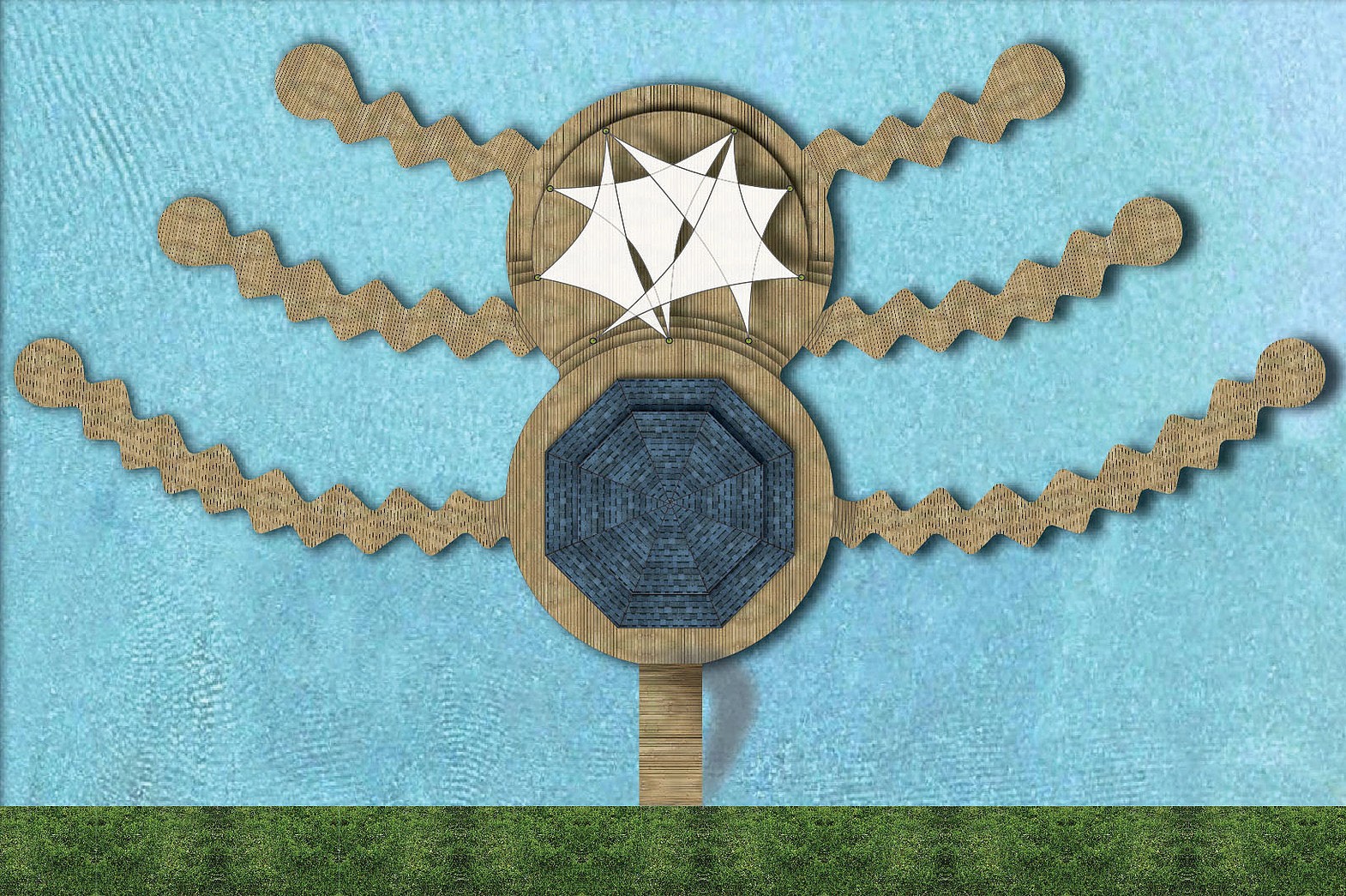
With a central covered meeting space, and boathouse on the dock, things like laundry facilities, social functions, and showers are more a part of your neighborhood than an afterthought in a parking lot onshore. Curved arms provide quick access to the sea, while jagged edges provide individual spaces, like back porches for boats to back into. It’s a place that brings a community together while giving them the opportunity to relish individuality.