nucleating a startup economy

nucleating a startup economy

As part of a systems engineering course in MIT's Mechanical Engineering Department, I set out to tackle a problem larger than any single product: how to create the conditions for innovation in one of America's most entrepreneurial, yet economically underserved, regions.

Rather than focusing on funding, incentives, or infrastructure, I explored education as the highest-leverage intervention, as it's an historical thread between all major tech hubs. The result was the "Startup Factory" — a new type of college designed to cultivate founders, retain talent, and generate mission-driven ventures rooted in the communities they serve.

Using systems engineering methodologies, the project demonstrates how institutions themselves can be designed to create lasting economic and social change.


2017

As part of a systems engineering course in MIT’s Mechanical Engineering Department, I utilized a model similar to my alma mater, Olin College, to design an institution to catalyze a startup economy in Mississippi — one of the U.S.’s most entrepreneurial, but underserved, regions.


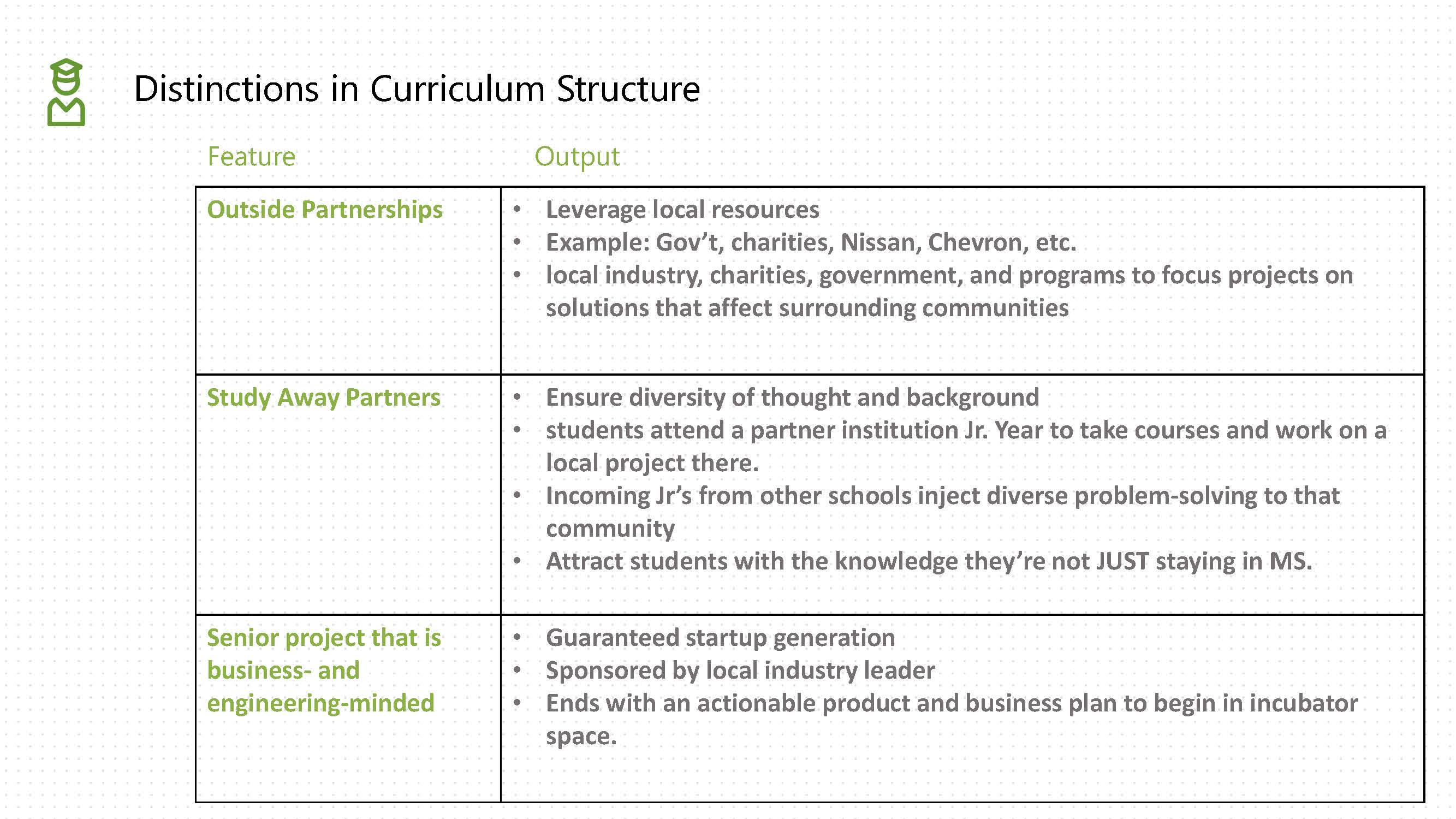
This “Startup Factory” is a mission-driven charter college that merges engineering, design, and entrepreneurship into a project-based curriculum. Grounded in systems thinking, the model tackles economic stagnation and "brain drain" by requiring every student to launch (or co-launch) a startup before graduation—each venture directly addressing local community needs. The proposal integrates organizational design, educational theory, and regional economic strategy to seed sustainable, founder-driven innovation from the ground up.


2018

SCOPE & OUTCOME

This systems engineering initiative explored how educational institutions influence regional economic development. Through systems analysis, organizational modeling, educational research, and economic evaluation, I examined the challenge of talent retention, startup formation, and innovation capacity in Mississippi. 

After evaluating a range of interventions—from incubators and funding programs to university partnerships and policy incentives—I identified founder development as the highest-leverage opportunity. The resulting concept, the "Startup Factory," reimagined higher education as a system specifically designed to cultivate entrepreneurs, launch new ventures, and seed a sustainable innovation ecosystem. 

We discovered that economic development could be approached not as a funding problem, but as an institution-design problem.

MY ROLE

Led research, systems modeling, institutional design, organizational strategy, curriculum development, economic analysis, and concept synthesis. Developed the Startup Factory framework, academic structure, implementation roadmap, and stakeholder ecosystem as part of an MIT systems engineering initiative.

🖥️ BELOW ARE SLIDES FROM A PRESENTATION THAT EXPLAIN THE PROJECT AND PROCESS.

BELOW IS THE APPENDIX FROM THE PRESENTATION.