
SCOPE & OUTCOME
This master's thesis explored how a federal institution might better support local educational innovation across diverse communities. Through enterprise architecture, stakeholder analysis, organizational modeling, concept generation, and systems evaluation, I investigated how organizational structure influences the quality and flow of insight within large public systems.
The resulting concept combined a community-based R&D organization with a nationwide network of embedded research fellows, creating a framework for gathering qualitative insights, sharing solutions across similar communities, and accelerating localized problem-solving.
I concluded that educational innovation could be approached not primarily as a policy problem, but as an organizational-design problem.
MY ROLE
Conducted enterprise analysis, stakeholder research, systems modeling, organizational design, concept generation, concept evaluation, implementation planning, and thesis development. Developed the final organizational architecture, operating model, and transformation roadmap as an independent graduate research project.
FULL THESIS
Below is a brief overview but you can view the thesis on MIT's Library website.
THE PROBLEM: BLANKET SOLUTIONS
The U.S. Department of Education has a two-part mission: make American education globally competitive, and ensure equal access for all students. But its own website acknowledges that curriculum, graduation standards, school facilities, and community programs — the things that actually determine outcomes — are almost entirely controlled by states and local governments.
The Department operates at the center of a problem it can't directly solve. That tension is the whole design challenge.
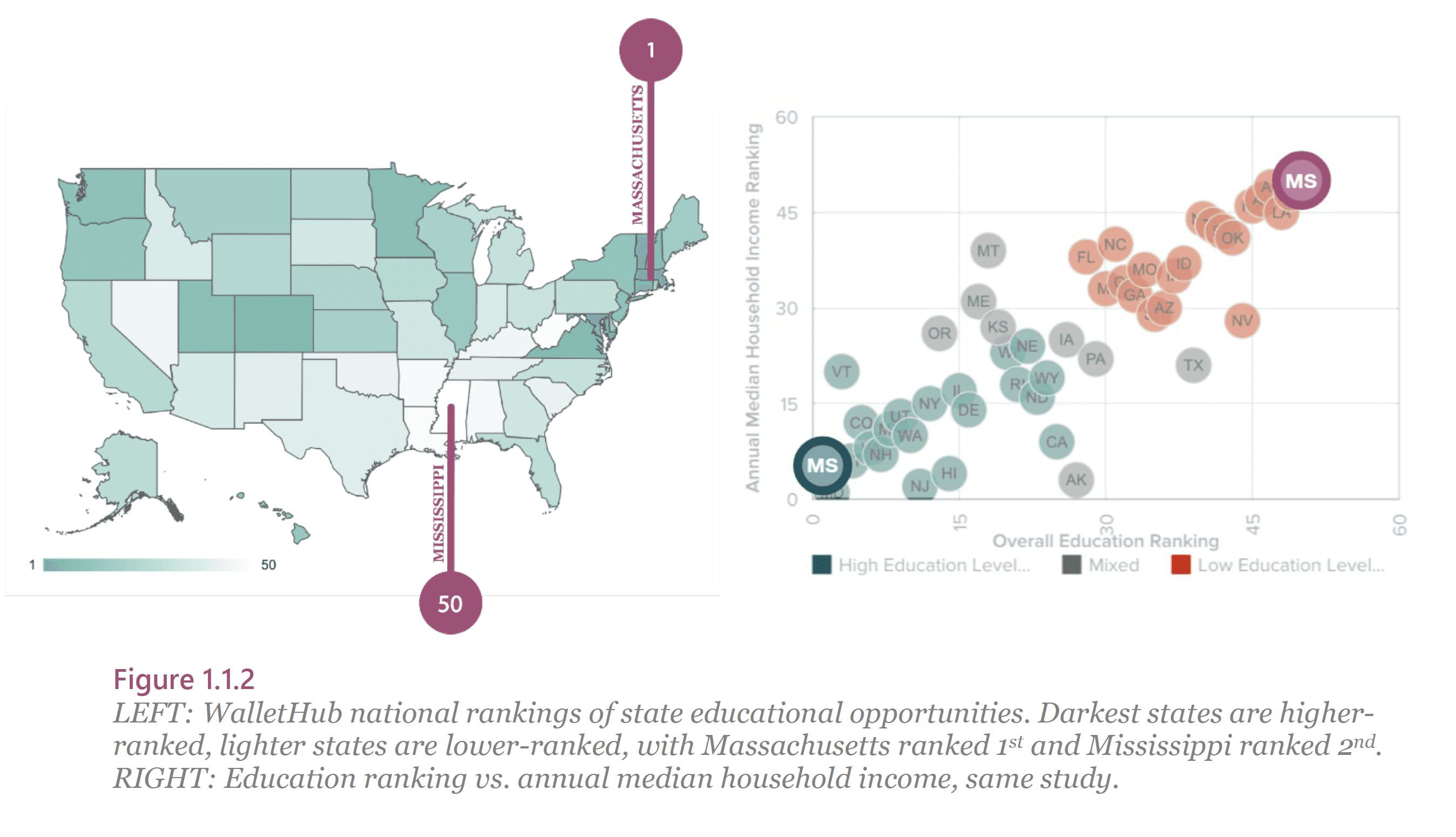
The national dropout rate looks like one problem. But high dropout rates in the rural Yazoo Delta of Mississippi and inner-city Detroit stem from completely different contexts — different resources, cultures, distances, and community structures. One policy can't address both.
Meanwhile, a rural town in Vermont and a rural town in Mississippi may have more in common with each other than either does with their own state capitals.
On top of it all: different areas are going to have different political views and goals, so any organizational solution needs to stay lean and provide the best information for decision-making at any level.
The existing architecture of the organization is unable to resolve these tensions, especially given the mounds of stakeholders involved.
THE METHODS: SYSTEMS ARCHITECTING FOR AN ENTERPRISE
Rather than designing a policy, I sought an organization that would generate better policies. I wasn't trying to build a better watch; I was trying to build the shop that empowers people to make good watches.
I used a variation of the ARIES enterprise architecting framework, which works outward from a current-state analysis before generating and evaluating alternatives. While normally I would be an advocate for early-stage user-research, this particular project was aiming to design a system for a massive range of people (every public elementary and secondary student in America), and a better understanding of the enterprise was necessary to frame stakeholders in categories that could be designed for within that system. To do this:
Extensive background research on the current enterprise was performed, analyzing organizational structure, mission, history, and problem definition, with results summarized in this document.
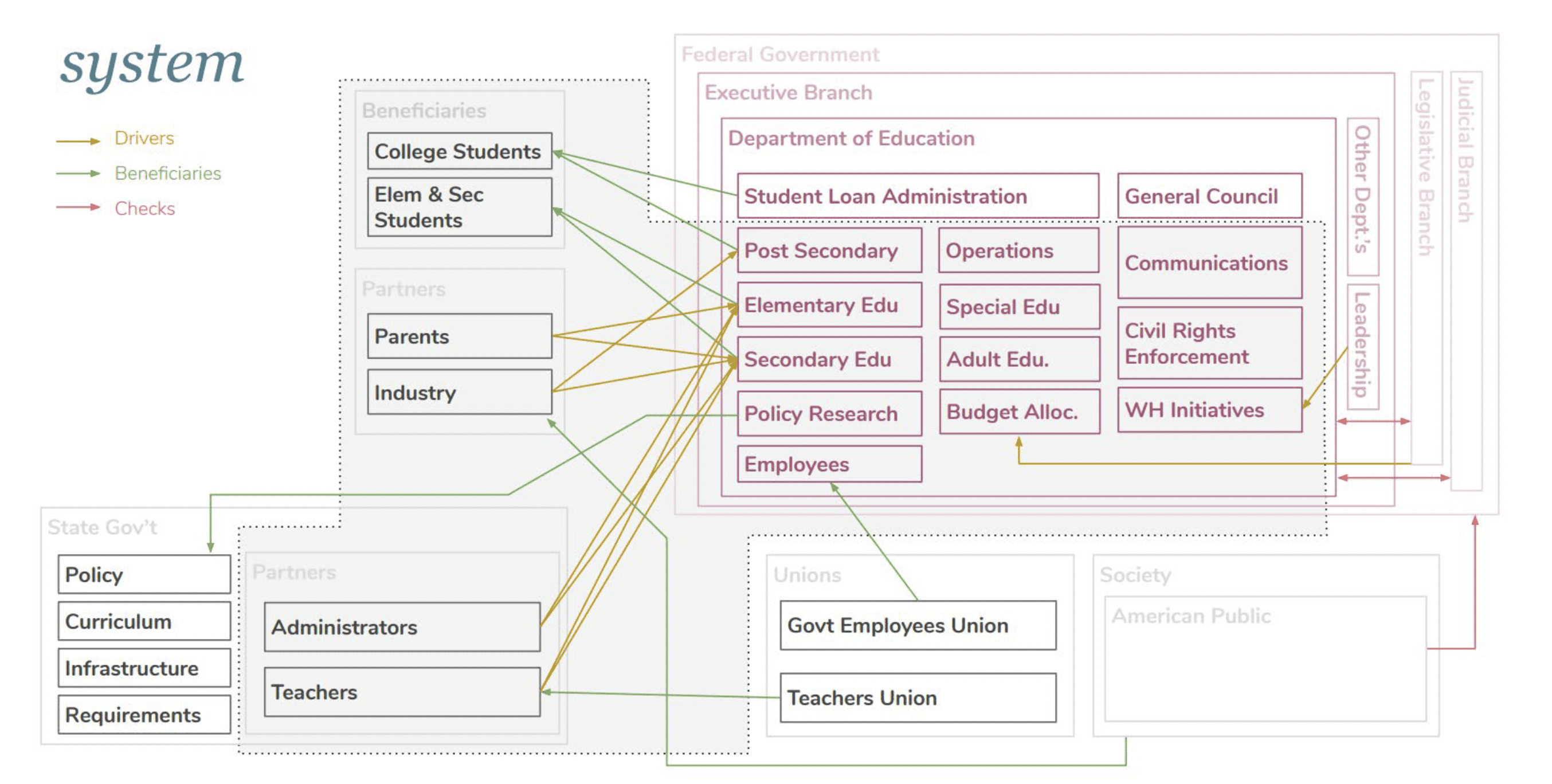
A mix of systems analysis methods were employed to break-down the enterprise, map influence, drivers, checks and balances, and value-flow through the system.
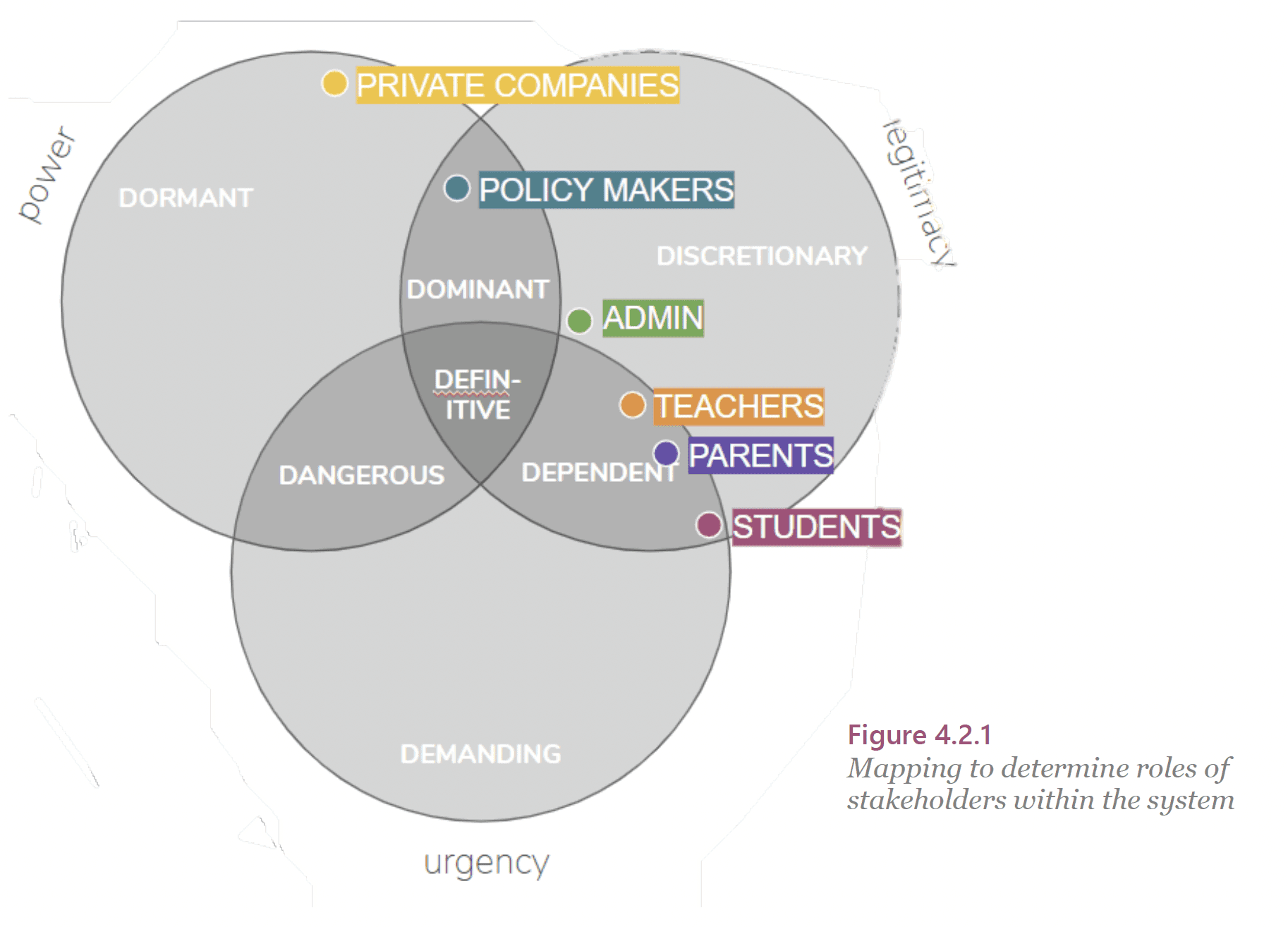
The place of various stakeholders within that system, and their relationship to the end goal of local ideation, were analyzed, mapped, and plotted in relation to one-another.
Values, experiences, and motivations for each of those selected stakeholders were analyzed and their level of power, legitimacy, and urgency in the enterprise transformation were determined.
A future vision of the enterprise was formulated, given the potential for localized problem-solving and targeted information-sharing.
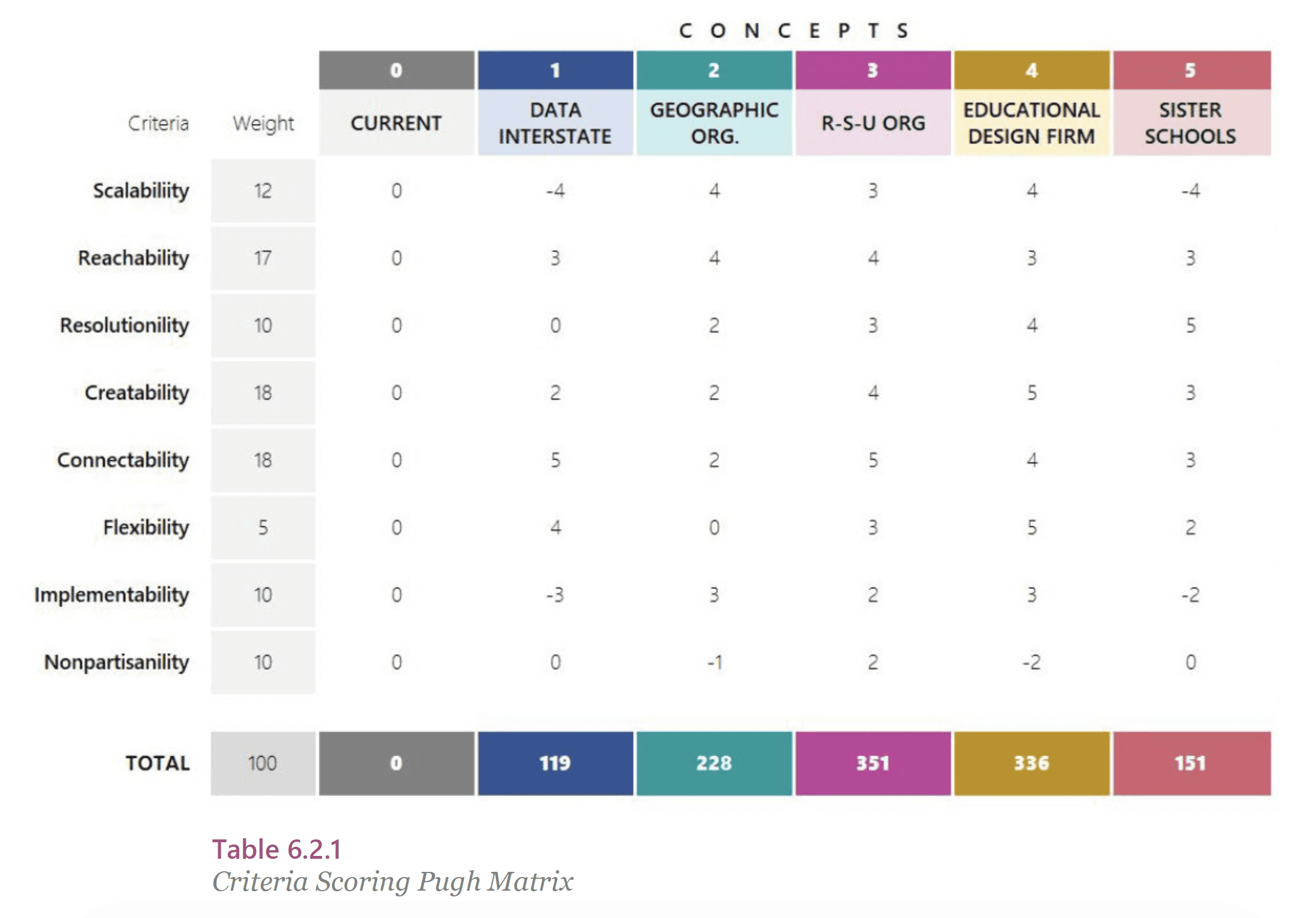
A number of concepts were ideated, with 6 shared here in comparison to the current enterprise structure.
Insights gained from the stakeholder analysis and background enterprise research were used to direct the design process in refining the ultimate concept before developing an example scenario vignette of operations, future-proofing, and potential implementation plan.
THE SOLUTION — A DEPARTMENT DESIGNED FOR IDEATION
The two highest-scoring concepts weren't just strong on their own — they were strong in opposite places. The Educational Design Firm's biggest risk was partisan bias; the RSU Matrix Org's granularity neutralized it. The RSU structure's weakness was distance from individual stakeholders; the design firm's on-the-ground fellows closed that gap. So rather than pick a winner, I fused them into a single dual-structure system where each half covers the other's blind spot:
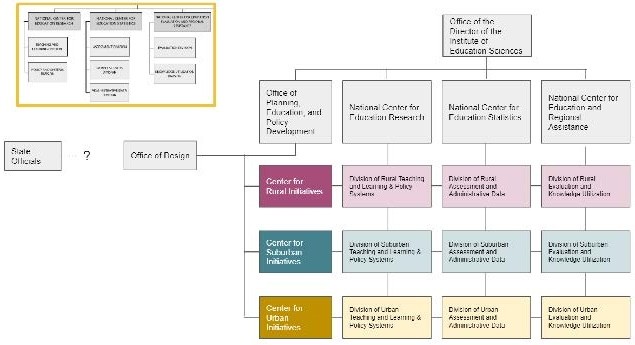
THE RSU MATRIX ORG reorganized the Department's existing research and development arms — the Institute of Education Sciences and the Office of Planning, Evaluation, and Policy Development — into three parallel tracks: Rural, Suburban, and Urban. Rather than organizing by geography or function, this structure ensures that insights, data, and initiatives flow between communities that actually share similar contexts and challenges. A rural school in Vermont and a rural school in Mississippi belong in the same channel.
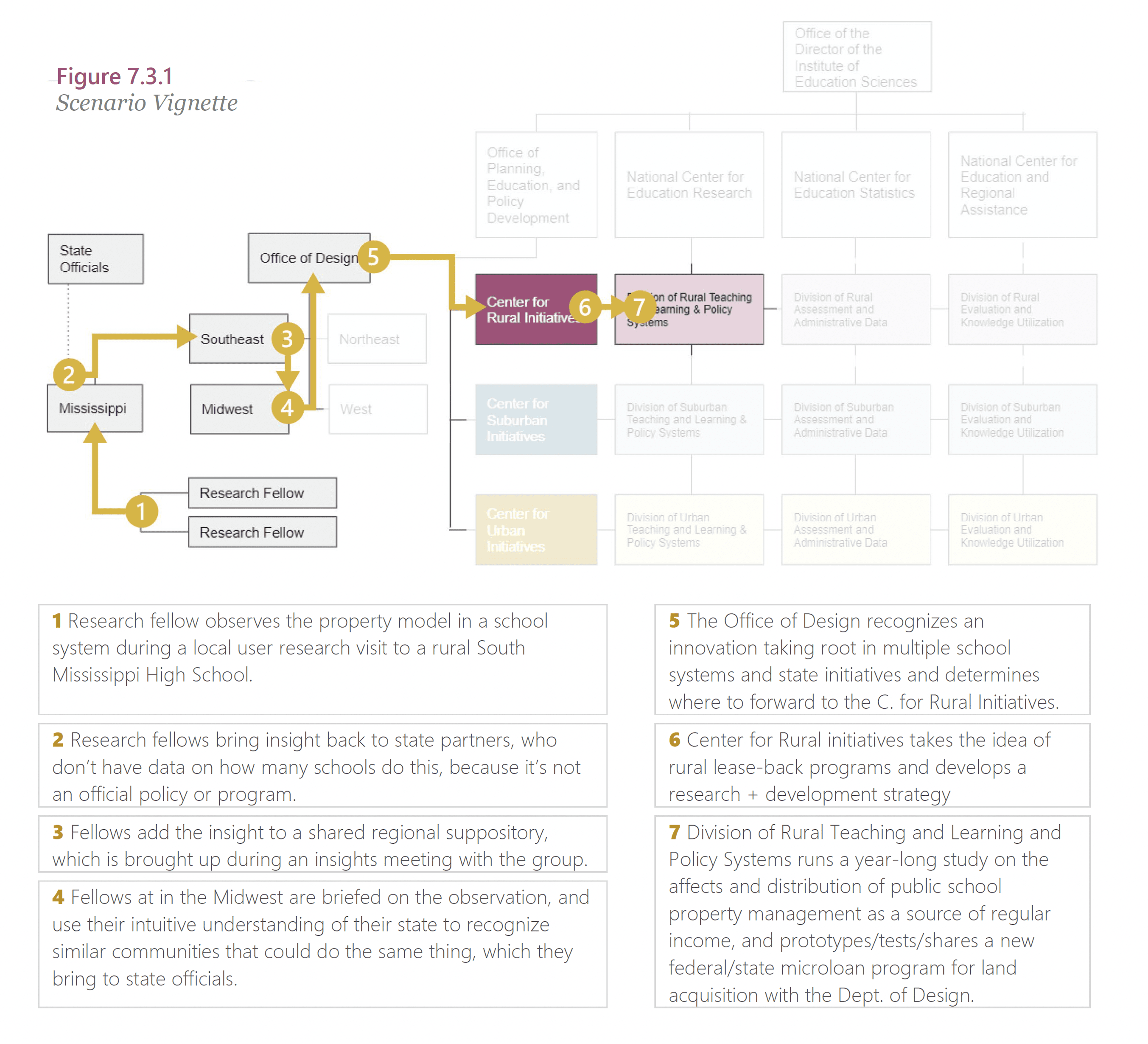
THE EDUCATIONAL DESIGN FIRM addressed the gap between federal research and lived local reality. Two research fellows — one in-state, one from outside — would be appointed to each state on rotating 2-year terms, conducting immersive, qualitative, user-centered research in communities across that state. Their findings feed upward into the RSU channels; federal insights flow back down to state officials through a central Office of Design.
THE RESULT: a Department that generates and distributes qualitative insight to supplement its existing quantitative data — and does so in a way that's targeted to communities most likely to benefit from it.